Showing posts with label YAV. Show all posts

31 July 2014

the WHOLE POINT of my YAV year

Since my last post, I have continued the trend of communion twice a week, except this week, I've helped serve it. That's right-- I'm now an ordained Ruling Elder in the Presbyterian Church (USA). This is my first step in figuring out how I'm going to follow this call to serve the church as an environmentalist. I had to make a lot of promises about my commitment to the church and to furthering the church. It was a very sweet and meaningful parting gift from my beloved friends at First Presbyterian Church of Bayou Blue.

 photo ordination2_zps2c544400.jpg

My last official day of work was July 23. On Wednesdays I give wetlands presentations to Project Homecoming volunteers, either as a walking tour of Bayou Sauvage if weather permits, or as a lecture at the Volunteer Village. It's been a really cool way to spread the story of South Louisiana and give a little geographic context to the people rebuilding New Orleans.

On Wednesday, July 23, the skies weren't looking promising, and the forecast showed scattered thunderstorms. I was very disappointed to spend my last evening of work, my last presentation, indoors. I was still very excited to talk about the wetlands and environmental conservation.

My talks last about 45 minutes, going over how the landscape of South Louisiana was formed, what has gone wrong with that environment, and what is being done to make it better. I get really, really excited. Sometimes I jump up and down a little. Sometimes I yell a little. But sometimes people find my enthusiasm inviting and come to ask me questions afterwards.

This is how I met Adam. He's from Georgia, and he's really excited about the church. He's really excited to stay with the church and do things in the church. We talked for at least half an hour about all of the different things we've been working on-- energy conservation in his case, natural resource conservation in mine, and what kind of ways we can connect to further this work in the church and beyond.

That is the whole point of this stuff.

The saving the wetlands stuff is important. The ministering to the sweet people of Bayou Blue is important. The intentional community is important. The exploring the incredible city of New Orleans and so much of South Louisiana and learning as much as I could and doing as much as I could is important.

But furthering the church-- I think that's the whole point of this year of service. I'm so glad I could take part in it.

18 July 2014

YAV year/life lesson 1 of ∞

I have averaged communion 2-3 times per week for the past month and a half or so, between Sunday mornings, various church meetings, and leading worship for a local summer mission program. This week, for example: Bayou Blue on Sunday morning, YAV closing worship last night, Project Homecoming closing worship tonight.

One of my favorite parts of communion in the Presbyterian Church is when the person serving it announces that "This is not a Presbyterian table. All are welcome." Actually, on Sunday morning, that was said both during announcements and during communion, which is what got me thinking about it.

I really like that.

I only have about a dozen days left of being a YAV in South Louisiana. This year has been a great opportunity for really getting involved with local churches, with a Presbytery, and with PC(USA). I am going to take about a thousand million billion infinity lessons from this year, but in the midst of this very difficult week I am very focused on this not-Presbyterian-table.

All are welcome at my table. Presbyterians, Catholics, Episcopals, Mennonites, Quakers, Muslims, Jews, athiests, Hindus, those who practice traditional religions, those who believe in everything, those who believe in nothing, and everyone in between. Everyone is welcome at my table. Palestinians and Israelis. Russians and Ukrainians. Children who arrive to the US border unaccompanied, and their parents and guardians.

Peacemaking has become an important theme in my work, brought out especially by working with the Presbyterian Peace Fellowship at General Assembly. As an environmentalist, I know that if we don't take care of our natural resources, there's going to be a lot less peace in the future. So far beyond that very basic premise though, I've been reading and learning and thinking about issues of peace around the world. All of these people who are so different from me, not just in appearance and location but circumstances and background and foreground.

It is fitting that such a difficult week end with the birthday of the late Nelson Mandela, who inspires so many people to work for peace. "Let freedom reign. The sun never set on so glorious a human achievement." he said. "Courageous people do not fear forgiving, for the sake of peace." he said. "It always seems impossible until it is done." he said.

I am not always a perfect peacemaker. (Neither was Nelson Mandela, truthfully.) I'm sure my brothers would agree with that. I'm sure my partner would agree with that. I'm sure my seven housemates in New Orleans would agree with that. This is one of the important lessons I am taking from this year though, this idea to constantly and intentionally work for peace. I won't always get it right, but to start, I will focus on this idea that everyone is welcome at my table.

Peace, salaam, shalom.

01 July 2014

Five Things I learned at GA/as a YAV

I preached at Bayou Blue again this past Sunday. I tried to record it for my parents, but the camera and microphone refuse to work properly at the same time. Sigh. I re-recorded it while sitting in the Tree of Life in Audubon Park yesterday evening (so you can hear the cicadas and crickets!).

Micah 6:6-8
Psalm 148
Romans 15:13
Matthew 5:13-16
Children's sermon: The Lorax by Dr. Seuss


The week before last, I was present at the 221st General Assembly in Detroit as one of the Presbyterian Peace Fellowship’s interns, and I was exhausted. I’m going to tell you more generally about my experience at General Assembly, and how nicely it ties into my year in service here in the Presbytery of South Louisiana.
            
I received an incredible education from countless organizations, commissioners, advisory delegates and observers in topics concerning environmental justice, peace in Israel/Palestine, and marriage equality issues, among many, many other topics. I learned about church polity, about exceedingly specific grammar, and about how every vote counts.
             
I felt the heavy sadness of the commissioners rejecting things I poured my energy and heart into, and the intense joy as other acts of just peace and equality were passed.
             
Of course, there were also the long waking hours and short nights of sleep on the floor of a nearby church, the rushing from plenary to strategy session to commission meeting to briefing dinner and back again, and the endless organization of emails, twitter feeds, mass texts, testimonies, and reflections.
             
I was exhausted physically, emotionally, and spiritually, but it might be the most beautiful kind of exhausted I’ve ever been. My cup is running over and spilling everywhere. The theme of the assembly was “abound in hope” from the Romans passage I just read, and I left feeling more hopeful about and connected to the church than ever before.
            
 I was very excited when Rev. Dick and Rev. Kris asked me preach about my time at GA. I decided immediately I would share what I learned about the church there. But the more I thought about what I learned that week, the more I realized that I was learning these things throughout the year through Bayou Blue and the Presbytery of South Louisiana. With just a few weeks left to my term of service, I thought I’d reflect on the entire year, which manifested itself very clearly at General Assembly. So without further ado, the five things I’ve learned this year as a Young Adult Volunteer in this specific church, this regional church, and this national church—
           
             
Number 5: Yes, I’m counting down backwards. It’s far more dramatic that way. Number 5: Education is important. Hence why I am preaching on “what have I learned from General Assembly and my YAV year”. Being in the reformed tradition, the Presbyterian Church holds the conviction that what is reformed must always be reforming, hence the need to learn and reassess constantly. The focus on education in our church is a longstanding tradition, dating to the earliest days of Presbyterianism during the Protestant Reformation in the sixteenth century. John Calvin and John Knox, two influential theologians of the time, were both very vocal advocates for free public education. Presbyterians often established local schools in their communities in the colonial days of this country, and later founded 65 colleges and universities as well as ten theological seminaries.
           
Education has been an important theme for my service in South Louisiana this year. I came to you with both an undergraduate and graduate degree in environmental geography. I love and value these studies very, very much, but could only be so prepared for what I would see and experience here, having never been to Louisiana before. Thankfully, you all and many other stepped in with a phenomenal field education. You had suggestions of which organizations I should connect with. You taught me about the trees that grow here. You taught me about the agriculture, the fishing, and the changing landscape. I am so grateful to this room full of experts, because it was a steep learning curve for me.
             
Education was also critical at our General Assembly. There were countless opportunities for briefings on all of the issues, from the Presbyteries that sponsored or concurred with the overtures presented, from the many observers from different organizations with different interpretations of the subjects at hand, as well as the option for independent reading and self-teaching as we went along. Different reports were made available to all in the assembly hall, updated as they changed. The leadership of the assembly strived to make sure everyone was informed of what we were discussing.
             
For me, it was an opportunity to learn a great deal from many perspectives about the issues in Israel and Palestine, a situation that I have never been too well-informed about because of how completely and unimaginably large and long-standing the problems are. I was too intimidated to even ponder where to start. I was finally given a starting point by a group of people who have spent years studying the issues and visiting the region, which encouraged me to read further and ask questions and eventually learn enough to form my own opinions. The little informal education I received was incredibly empowering. Just imagine the impact this church has in so many formal education settings!

             
Number 4: PC(USA) is a church full of connections and relationships. When I worked for New Jersey’s only Presbyterian camp, I would visit churches and presbytery meetings for all seven of the state’s presbyteries. Not only that, but I worked with people from all over New Jersey for the summer camp program. I met a lot of pastors, church leaders, and young adults in those years. It felt like everywhere I went in NJ, I could find the nearest Presbyterian church and know or at least know of someone in that congregation or Presbytery. It constantly felt like six degrees of separation, or even less most of the time.
             
That continued as I came to Louisiana. Three of my housemates grew up in New Jersey, and we all crossed paths many times, through that camp, through our churches, and in the case of one, even by going to the same college. We never met before we lived together, but we have many shared people, places, and experiences. Even more small worldly, one of last year’s New Orleans YAV’s was my camper at that summer camp in New Jersey about ten years ago.
             
Of course, I found a connection in this sweet little congregation here at Bayou Blue. You have treated me like family from the start, always telling me I’m related to you all “by affinity”, but affinity wasn’t enough. About halfway through the year, I found out Miss Billie Robertson’s maiden name was Earp, just like my own name. And let me tell you all—there aren’t too many Earps in this world. So while we haven’t figured out exactly how we’re related, I am absolutely positive that we share a family tree. And since many of you are related to her in one way or another, it seems like you’re stuck with me actually being part of your family.
             
This incredible network within the church extended easily to Detroit. Aside from running into plenty of people I know from Presbytery of South Louisiana and various presbyteries in New Jersey, I met and served alongside many other people who are familiar with this church. I met Ms. Andree Tarrant, who spent time with you while serving with the Coast Guard in the area after Hurricane Katrina. I saw many of the Presbyterian Hunger Program people who came to visit us and hear your stories just a few months ago. I worked with the director of Stony Point Conference Center, where my YAV orientation took place, and with one of the pastors who I met on the Eco-Stewards trip a few weeks ago—you know, the one where I swam with the manatees, which I like to shamelessly remind everyone about every chance I get.
            
In the Presbyterian Church, we work to build a great network, a great cloud of witnesses, a great family. It is an incredible group to be connected with.

           
Number 3: This church includes all of us as ministers, ordained or not. To be a minister means to give service, care, or aid, or act as the agent or instrument of another—in this case, God, Christ and the Holy Spirit. Seminary degrees and ordination help our pastors to do this in a more official manner, but as members of this church, we all get to be instruments of the Lord.       

This kept surfacing throughout my week in Detroit. Sure, many of the people ministering to me are ordained, as one might expect of a gathering of hundreds of church members and workers. There was the pastor from my home Presbytery who recognized me early in the week and excitedly shared updates from New Jersey. There was the pastor involved with Presbyterians for Earth Care who I met in the fall, who encouraged me and included me in her work throughout the week. There were the elders from this Presbytery attending the assembly who brought a bag full of snacks for me, just to cheer me on for being there. There was the college chaplain who offered a hug following a difficult decision on the assembly floor that I was struggling with, and the pastor I met at the Eco-Stewards conference a few weeks ago who sent support via text message, as his flight left before the vote.
             
But there were so many others ministering to me, acting on behalf of the Holy Spirit and caring for me, without any sort of ordination. There were several former YAV’s working with the Peace Fellowship who provided meals, listening ears, and guidance throughout the week. When I fell ill with a fever on Tuesday morning, they made sure the things I was working on were covered so I could get myself to a doctor. There was the friend with the Peace Fellowship who always seemed to show up with the car keys in his hand when I desperately needed a change of scenery. There was the former camp director who now works in the national church offices who cheered me on for my involvement in the church. Some of the Presbyterian Hunger Program people who visited us a few months ago asked how you all were doing, asked how my work on the coast was, asked how things are in Louisiana. There was a fun group of Peace Fellowship people who ventured to a grocery store ten miles outside of Detroit late at night because they decided we could all use some ice cream. All of these small interactions, all of these bits of encouragement and love—all of these things were forms of ministry, unordained.
             
This is just like this very congregation. Some of you are ordained as elders, but all of you, yes, all of you, have ministered to me in different ways this year. You have asked about my work, encouraging me as I faced many challenges during the year. You have invited me into your homes for a meal or just to catch up. You have asked how I was doing, settling into Louisiana, so far from my family. You have shown me around your community, teaching me what I needed to know in order to best serve here (see, there’s that education stuff again). You have supported the YAV program since long before I came here, and have been enthusiastic about the program since my arrival. In all of these ways and many more, you have acted as instruments of God, partnering with me in a ministry that is so much bigger than any of us as individuals.
           
             
Number 2: This church takes discernment very seriously. This is a word that Presbyterians love. The interview process for becoming a Young Adult Volunteer is one of mutual discernment, that is, I figure out what feels best for me as an individual while the program figures out what is best for it overall, and then we sit and ponder what the best possible outcome of those ideas might be. In my case, it was fairly straightforward: Louisiana was clearly the best option for me. At General Assembly, it was far more drawn out, weighing every possible angle of every possible decision to be made.
             
Nothing was taken lightly. Every overture was considered by an individual committee with about fifty voting commissioners, plus a dozen or so resource people and advisory delegates. Dozens of people would observe each committee and testify, each with another perspective. Conversations would become tediously long at times, but it would follow rules of order to make sure as many voices were heard and considered as possible.
             
This year, the GA tried something new and hosted two discussion periods on the floor of the assembly, to make sure that the commissioners had adequate time to learn from each other and consider as many options as possible on some of the more intense overtures, since everyone sat on different committees. Even aside from that time, many of the overtures brought lengthy conversation. No decisions were made without first hearing at least a few carefully selected testimonies for and against the topic. The assembly deliberated for hours over marriage and Middle East issues. It may sound like a special kind of torture, but I was very excited that environmental issues brought an hour and a half of conversation to the floor. There were no snap decisions made. Everything took a great deal of time and energy to make sure that we were doing the work of the church as best we could.
             
I think this is true here for Bayou Blue as well. It may be a smaller body, so conversations hopefully don’t take as long. I have heard many session meetings called, sometimes last minute, to consider things that need considering. Discernment is important.
       

And the Number 1 thing I learned at General Assembly and as a YAV this year: I am called to do this work. When I applied to the YAV program, my interviewers noticed I was a few years older than the average Young Adult Volunteer. One of the interview questions was of course something straightforward like, why do you want to be a YAV? It had been five years since I had graduated from college at the time, and I was frustrated that I had not been able to find a full time job despite my best efforts. I wanted to serve as a YAV because I wanted to listen a little more intentionally for that still, small voice guiding me toward the right thing.
             
It’s hard to hear that still, small voice over ALL OF THE YELLING. Holy Spirit has not been shy with me at all. I absolutely love serving Bayou Blue and the Presbytery of South Louisiana as an environmental conservationist, planting trees and grasses and teaching others why that’s important. But it all came together for me last week in Detroit. Late Friday night, I found myself beyond tired. I was quite miserable for a little while, time I spent alone in the church where the Peace Fellowship was staying. I could not comprehend this exhaustion. It was far more than just being sleepy after a long week of work. It took me a while to realize that I was completely exhausted because I had poured out everything I had, my energy, my heart, and my spirit, over dealing with environmental issues at the General Assembly. I had used every gift God gave to me to do this work for the church. This is not about me liking this environmental work and just wanting to do it because I want to, but because God has given me the right gifts for this work and has guided me to the point that I know I need to use them in this way.
            
 I focused on education. I spent months learning about the issues in preparation, and many hours present in Detroit to fine tune that knowledge and clarify my questions. I spent time in conversation with individuals and groups, making sure I was as educated as possible as I testified and took part in bigger discussions concerning the church’s relationship with creation.
             
I built relationships. I spent a lot of time connecting with new people and groups, to make sure that I was reaching everyone I needed to and everyone I possibly could. There was so much encouragement and support.
            
 I was ministered to by many people. I like to think that I offered some ministry to others as well, not to bring my will about, but to serve God’s will.
            
 I did not arrive at this lightly, but spent every waking moment possible since then trying to figure out whether this sense of call is completely crazy or not, although some very kind ministers have told me that’s what discernment really is. I’m not entirely sure how this sense of call will play out, but here I am, discerning.
           
I did each of these things in my role here as your YAV, too, and I was so blessed to have Bayou Blue with me every step of the way, teaching me, befriending me, ministering to me, and entertaining big questions with me. My entire year of service in the wetlands and this church has built up to this.
             
So here I am, with this sense of call that I need to continue to be a voice for the environment, much like The Lorax I introduced you to earlier, but I need to continue doing this for the church. It’s not that I need to exhaust myself beyond recognition, it’s that as soon as I realized why I was so tired, I felt fulfilled.
             
When I was commissioned during my orientation in New York before I arrived to Louisiana, the verses from Matthew were used, about being salt of the earth and light of the world. I have tried hard to live that out this year. Salt of the earth: good, humble people just like salt is a good, humble seasoning. Light of the world: we are calling to let our God-given gifts shine and light the way for those around us. I have been shining as brightly as I can all year, but especially in Detroit.
             
I applied for the internship with the Presbyterian Peace Fellowship because I wanted to go to General Assembly to see the bigger picture of the church I grew up in, and am serving this year as a Young Adult Volunteer. It has been a great opportunity not just to see that bigger picture, but also to connect with it, and it has left me full of hope. I am part of a church that is happening, and I want to continue to be part of that church. In fact, not only do I want to continue to be part of that church, but I am feeling called to be part of that church, to continue to be a loud voice for the environment for that church. That week in Detroit has been full of discussion and discernment as well as opportunities to learn and to love. As a church, we have taken risks to include others and encourage peace, not because they were the easy answers, but because according to Holy Spirit, they were right answers. That exhaustion passed, but I believe this church will continue on. And here I am, part of that picture! Amen.
 photo extra7_zps92654902.jpg

23 June 2014

General Assembly


Last week, I was present at the 221st General Assembly in Detroit as one of the Presbyterian Peace Fellowship’s interns, and I was exhausted.

I received an incredible education from countless organizations, commissioners, advisory delegates and observers in topics concerning environmental justice, peace in Israel/Palestine, and marriage equality issues, among many, many other topics. I learned about church polity, about exceedingly specific grammar, and about how every vote counts.

I felt the heavy sadness of the commissioners rejecting things I poured my energy and heart into, and the intense joy as other acts of just peace and equality were passed.

Of course, there were also the long waking hours and short nights of sleep on the floor of a nearby church, the rushing from plenary to strategy session to commission meeting to briefing dinner and back again, and the endless organization of emails, twitter feeds, mass texts, testimonies, and reflections.

I was exhausted physically, emotionally, and spiritually, but it might be the most beautiful kind of exhausted I’ve ever been. My cup is running over and spilling everywhere. 

I applied for the internship because I wanted to go to General Assembly to see the bigger picture of the church I grew up in, and am serving this year as a Young Adult Volunteer. It has been a great opportunity not just to see that bigger picture, but also to connect with it, and it has left me full of hope. I am part of a church that is happening. This week has been full of discussion and discernment as well as opportunities to learn and to love. As a church, we have taken risks to include others and encourage peace, not because they were the easy answers, but because according to Holy Spirit, they were right answers. The exhaustion will pass, but I believe this church will continue on. And here I am, part of that picture!

18 June 2014

how far I've come

Greetings from the whirlwind we call General Assembly! I'd hoped to update more during the week, but I have kept incredibly busy as a Presbyterian Peace Fellowship intern. Also I fell ill with a viral throat infection, so the vast majority of my free time is spent unconscious, drinking tea, or... no. I haven't had free time yet. But I have been loving this (minus the abscesses on my throat).

First, let me say, I adore PPF and feel so honored and excited to be one of their interns. This is a group of wonderful people who are open minded and ready to be challenged, responding with grace (no seriously, read that link, that letter and the press conference we put together in under 3 hours to support it were really amazing). An organization started to support conscientious objectors in WWII, PPF is celebrating 70 years of peacemaking through justice of all kinds-- social, food, environmental... we have talked about drones, about BDS (boycotting, divestment and sanctions), about gender and marriage equality, about fossil fuels...

I am loving this.

I have probably a hundred thousand million billion more things to say, but I wanted to talk about two horrible ironies in my life this week: the oil slick experience I had a few weeks ago, and the laptop on which I am writing this.

I testified before Committee 15 regarding fossil fuel divestment, in partnership with PPF as well as Fossil Free PC(USA), Presbyterians for Earth Care, the Covenant Network, and other great people and groups. We heard many, many testimonies in favor of divestment, mostly focused on climate change. I talked about the irony of swimming through oil while planting bullrushes to restore the banks of a river badly eroded by the oil industry. Investing in fossil fuels undermines this work I've been doing, that the church has told me is important. Supporting environmental damages is inconsistent with preaching that the earth is precious and worth caring for.
 
Another big topic PPF is focusing on this General Assembly, is that of divesting from three companies that have supported Israeli occupation of Palestinian places, bulldozing homes and trees. Those companies are Caterpiller, Motorola, and... HP. Hewlitt Packard.

I am writing this from an HP laptop.

I bought it six years ago when I started teaching at Rutgers, because moving a desktop around might have become a bit tedious. It was a good price, had a reputation for being a good machine, and plus I really liked the commercials that were on at the time:


I am learning a great deal about Middle East issues this week, not just through the eyes of the Peace Fellowship, but many other organizations and individuals weighing in.We're mostly discussing Israel/Palestine, an issue that the great Desmond Tutu has spoken about. Wearing a PPF shirt and carrying an HP computer felt a little ironic and inconsistent.

I'm human. I'm not perfect, even at the stuff I believe in. I am passionate about conservation, but I still drive a car all over the place. I lose my patience and speak violently even though I believe in peace. I'm not perfect, because I'm human, but I'm trying. I'm learning. I'm doing my best to share what I learn in productive, peaceful ways.

So, is it a little strange to serve PPF and use an HP? Yes. But I can't know everything. So maybe the HP isn't so awful, but is a sign of how far I've come. When I do learn things, I will do my best to live it out-- I'm learning a lot this year about voting with my dollars (and/or future computer choices). In the meantime, the environmentalist in me will use this laptop until it is dead, and as an associate of the Peace Fellowship I will keep my mind and heart open. I think that's ok.

07 June 2014

Eco-Stewards Gainesville

I apologize that this has taken a few weeks to post. Immediately following my incredible trip to Gainesville with the Eco-Stewards, I hosted my childhood bff in New Orleans, along with a visit from my partner and one of his friends, and then I had surgery to remove a stubborn wisdom tooth from my sinus and jaw (I'm not sure how it could be in both places at once, but it sure made a mess; also its neighbor was removed from the other side of my jaw, good times in my face). So now that I've slept off the anesthesia and my brain is not totally being hijacked by pain medicine, I wanted to tell you about the beautiful things I saw in Gainesville as part of this year's Eco-Stewards program:


Just kidding. I don't know where to begin.

We toured a beautiful organic farm, an incubator kitchen, talked with the Coalition of Immokalee Workers about fair labor conditions for farm workers, went to some really great coffee shops, and visited a ton of incredible places: Payne's Prairie, a community garden where you pick and you pay what you can, a farm to school program, a farmers market, the Gainesville Catholic Worker, a microfarm, and a church yard community garden, biked 20 miles to the Alachua Conservation Trust to tour Forage Farm and talk about water issues with the Florida Springs Institute. We ate amazing local foods, and learned about the connections between all of these places. There is some beautiful work going on in Gainesville, feeding the hungry and loving the earth. To top it all off, we hiked the Devil's Millhopper and tubed the Ichetucknee. I'm sure I'm forgetting a few stops but it was a week of constantly amazing things.

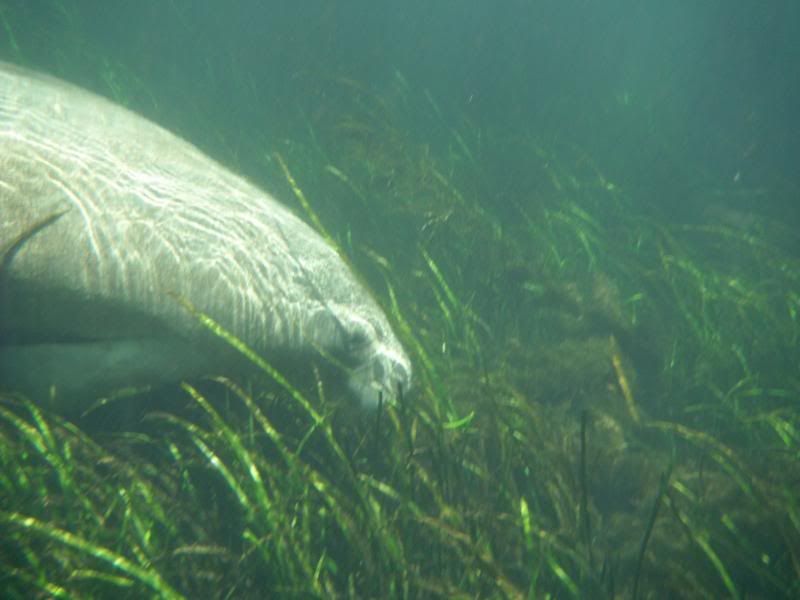
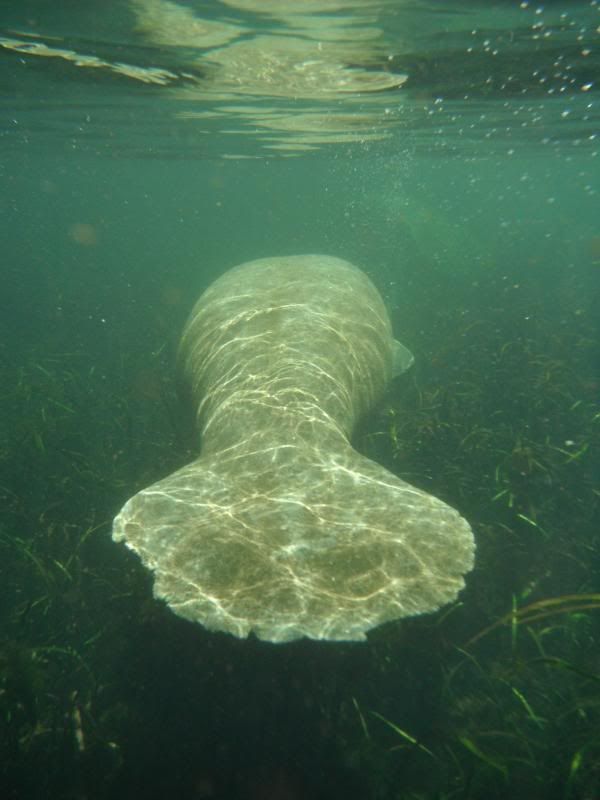
And, of course, I would be remiss not to mention that tubing the Ichetucknee lead to swimming alongside manatees as they moved up the beautifully clear spring-fed river. Yep, I just dove in and swam beside these two incredibly beautiful creatures.

 photo DSCF0244_zpse3dc6b2f.jpg

 photo DSCF0247_zpsf07ba66a.jpg

Keeping up with them is a lot harder than I would have guessed. They're so big and slow and graceful, but also very strong. We floated so slowly down the river that I was surprised how hard it was to swim upstream. I was also just a little bit excited, so holding my breath long enough to be underwater, take pictures, and kick frantically without scaring the manatees was a challenge.

It was a really amazing week to come together with other people interested in the relationship between faith and environmental work. As we all reflected on how awesome the Eco-Stewards program was, and how good it was to connect with this sort of buildingless church that the program has created, it came up that these kinds of great experiences kind of carry us for a while. A week like this is fleeting, but so deeply moving. And in the face the church being a complicated place for many young adults, it's kind of important to find these beautiful things to sustain us while we sort out the tough stuff and figure it out for ourselves.

While deep in the throes of that conversation, Rev. Rob Mark, one of the trip leaders, piped in, "...like the manatees..." Yes, exactly like the manatees. So incredibly beautiful, and only with us for a very short time, but I think about it every day. Not just manatees. The whole week of connecting with the great things going on in Gainesville and the church.

Will that excitement wear off? Perhaps, just like the manatees kept swimming up that clear, cool spring. But it leaves me with a sense of hope in what I am doing, and encourages me to keep seeking out the church in the world like this.

13 May 2014

Today, I swam through an oil slick.

I'm having a fantastic week. Today was day 2/5 of planting projects. Plants! All week! Doing conservation!

 photo DSCF0010_zps08ee9723.jpg

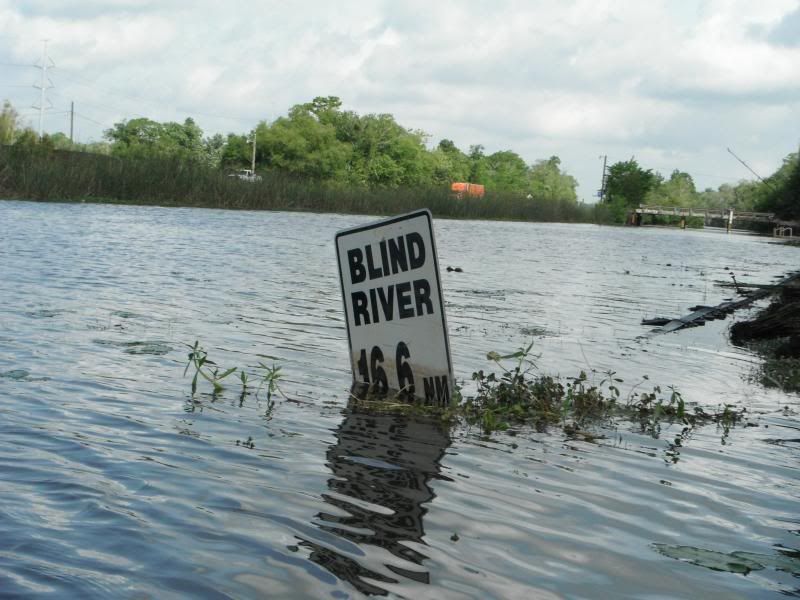
Today's project was putting about 800 gallon buckets of bullrush along the edge of Blind River in St. James Parish. This was to protect a bulkhead from further erosion. I love planting in water! The river was really high because of recent heavy rains and a strong south wind earlier this week, so the banks were flooded. The ground was a mixed bag-- really mucky and easy in some places, really hard and requiring a dibble or sharpshooter in others.

 photo DSCF0008_zps5c7e0f8f.jpg

As we were really struggling to get the rushes to stay. in. the. ground. along this particular area, I imagine we looked pretty funny from shore. We would just stand still in one spot for a while, basically treating the root ball like a pogo stick trying to get it to stay in the thin layer of mucky soil in water that was chin deep. So I'd look around a little bit because I couldn't see what I was doing anyway.

 photo DSCF0011_zps547542df.jpg

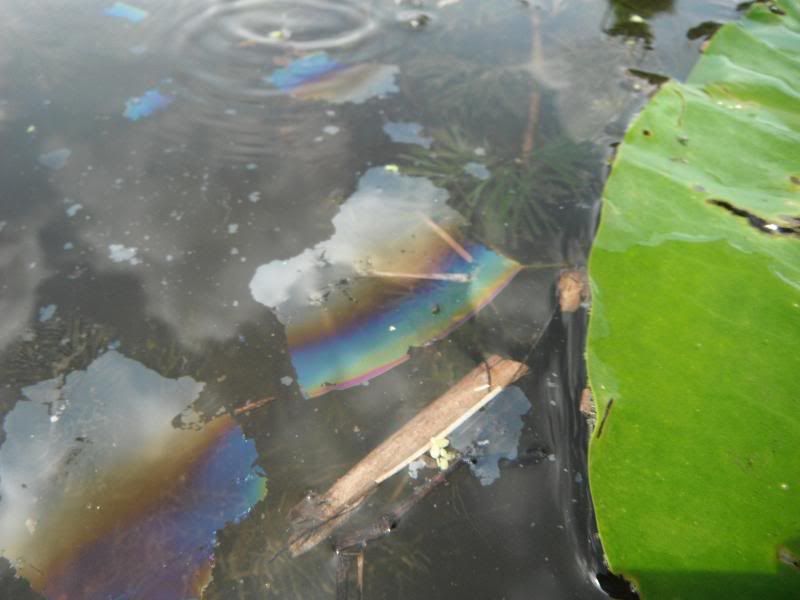
I was startled at one point in this stretch to notice something almost reddish to my right. At first, I thought I was bleeding. I checked my arms to see if I had nicked myself or something, but nothing. It kind of dissipated. I finally got the rush in the ground, and stepped sideways to plant another one, when I noticed I was in a pool of oil, all rainbow and shiny.

 photo DSCF0014_zpscd357867.jpg

As soon as I moved, it began to break up slowly and spread out. It was really bizarre, because I imagine oil and water to look kind of blobby like when you pour vegetable oil into water. I suppose without the limitations of the bowl or measuring cup, the oil spreads out very thinly. The edges looked so strange.

I didn't think much of it at the time, because we still had a bit of work to do and I really enjoy that work. On my drive back to New Orleans, I began to contemplate good and bad things that happened to me during the week, because it's Tuesday-- we have house meetings on Tuesday nights that generally begin with our highs and lows. High: I have five days of planting projects IN A ROW! Low:... wait a second, swimming through oil was messed up. Really messed up.

Full disclosure: I didn't actually say "messed up" in my head.

The more I thought about it, the more angry and sad I got. This is almost definitely not oil from that epic oil spill several years ago that is still producing tar balls and mats down along the Gulf. It's far more likely that this was just a leak from someone's boat, or an example of one of my biggest fears in South Louisiana: some slow leak of an oil pipeline that no one is watching.

Was swimming through oil good for me? Probably not. One of the few things I'm cynical about in this world though is health risks. We risk our lives every day by exposing ourselves to highly processed foods, cell phones, plastics, and sunlight. This alone will not give me cancer.

Just nightmares.

I'm sad that this is the reality of this environment, and so many others. I'm sad that I have to put myself in situations like this, that are questionable to my health, to do some good work. I'm really, really sad and angry and frustrated and helpless about how much we rely on oil and gas in the world. I mean, I'm really guilty (two roadtrips across Canada, a roadtrip around the eastern US, a roadtrip to get to Louisiana, even just driving to the site today was an hour to Thibodaux and another 45 minutes to get to the park where we planted; I've flown once a month every month since December till this month, and will be getting on a plane again next month).

Witnessing human impacts on this planet is exhausting me. It is really hard to convince myself to get up and work when it feels like I'm fighting a losing battle. What's easy here, is to get completely overwhelmed. Things are bad here. Really bad. And not just here.

All I can do is focus on the little things. Like each blade of bullrush now planted along the banks of Blind River. And all of the bitter panicum, phragmites and cordgrass we're putting into the ground on the north shore of Lake Pontchartrain tomorrow, and all of the sand live oaks going in the ground later this week. And all of the people who have listened to me talk about the wetlands here in Louisiana, and here on this blog. Thanks for reading this. Change won't happen all at once, but I can still add a little bit at a time, and so can you.

10 May 2014

I'm a young adult who wants to stay with the church!

I don't really know where to start with this one, but I have some feelings I want to put in writing while I'm on this crazy spiritual journey of vocational discernment. It's been an interesting few years navigating my relationship with my church and The Church, especially this past year as a mission worker. I've had some really great GREAT conversations this week with wonderful people working for the church all over the country, some at the national level, that leave me feeling hopeful.

Some of these conversations have surrounded the fact that I'm going to General Assembly as a Presbyterian Peace Fellowship intern, to sit in on the (Immigration and) Environmental Committee (parenthesis are mine) and get sent to the Presbyterians for Earth Care lunch. Or, in one pastor's words, I'm a big ol' "Presbyterian hippie". True, and I'm growing quite fond of that as my angle from which to approach the church.

One of the conversations this week had to do with my fears of growing out of my "young adult" age group before I can really embrace being part of it, and contribute to The Church as one of those elusive young adults.

I've also had several conversations this week about environmental and food initiatives at Presbyterian camps and conference centers. One was a conference call with a lot of people doing great work in really lovely places, all directors at different camps around the country. I introduced myself something like, "I'm Colleen, and I don't currently have a camp or garden, but I am (doing all sorts of environmental work with YAV) and (have a long history in camping ministry), and I'm a young adult who wants to stay with the church!" to which people responded with some Amens and Awesomes and even a Bless You, Child.

That last one was kind of the opposite of what I was going for with the whole trying-to-be-successful-at-being-a-young-adult-in-the-church thing, but I appreciated the sentiment.

After the camps phone conference, one friend on the call, who works for the national church, followed up with me individually. We talked a lot about what the national church is doing to hang on to and connect with young adults, and he offered me personal encouragement and support.

And I do feel encouraged and supported. I'm feeling really hopeful about what this denomination is doing, and I want to be part of it. I'm still floundering on a local level, but I'm not giving up. I'm still enjoying learning, and exploring different faiths and worship styles, and being part of a lot of good work happening through different congregations. Doing environmental work for the church is really exciting. I feel like I'm part of something big, some change in the conversations: for the environment, kind of reversing this idea that God created earth and left us in charge to do whatever we want; for the young adults, that we still matter after we're too old to be in youth group but before we're old enough to have kids in youth group. I'm not even quite sure what it is yet, but it feels good to be connected to a lot of good people doing good work. My relationship with The Church is getting pretty good, which motivates me to keep working on my relationship with the church/ my church despite the many challenges that entails.

04 May 2014

Third time's the charm...

...unless you're talking about my Masters thesis, in which case, tenth time was the charm.

Speaking of my Masters, I really haven't had but a handful of half cups of hot coffee since then. I took my coffee with milk, and the shelf-safe milk in Mexico really, really upset my stomach. I still liked iced coffee all this time, with milk, but if I wanted a hot beverage, I'd stick to tea. 

Well, last week when I visited Lafayette to preach, I poured a small cup of hot coffee before realizing there was no milk left. Not wanting to waste it, I figured I'd just suck it up and suck it down.

But I liked it.

Just to test this, I had a cup of coffee, black, with my friend Miss Ruth while visiting her in the nursing home, and another cup of coffee, black, during my early morning drive to Baton Rouge for a meeting yesterday. 

And I still like it.

I've always thought myself to be a reasonable blend of my parents, though perhaps more strongly resembling the Spains in many ways. However, despite my lack of blue eyes, despite the fact that I'm kind of average height, this is a clear, direct connection to my mother and her people. I can't believe it either, but I like my hot coffee pollutant free now. (Iced coffee will still require milk. Mmm.) (And let's be clear: I still really, really like tea.)

Growing and changing is good. As I mentioned, I preached in Lafayette last weekend. I also preached in Morgan City this winter, and this morning, I preached at Bayou Blue. It's changed a little bit each time, but I've generally been preaching about my work in the wetlands in South Louisiana, and water issues in general. I'm a little nervous, but I thought I'd share a sort of composite of my sermons. Consider this a Presbyterian environmental geography lesson:


Isaiah 43:16-21

Acts 2:14a, 36-41
Psalm 65

Psalm 104:1-13 
Romans 8:18-25 

John 1:1-5 

John 4:7-15
 

I am here today to talk with you about water. April 22 was Earth Day, and with a little help from curriculum put forth by Creation Justice Ministries, many churches are celebrating creation through the lens of water.
             
Now, I love water. I grew up in coastal New Jersey, a town called Toms River, nestled between two rivers, a bay and the ocean, as well as a beautiful stretch of brackish wetlands. My childhood memories of summer are almost entirely connected to these beautiful places. Surely there are a few rivers, lakes and bayous, or perhaps even the Gulf of Mexico that you have similar memories of. The other connection I had growing up to water in my hometown is that it was very, very polluted—a chemical company had buried hundreds of drums of waste, drums that were not sealed properly and leaked toxins into the local water supply. There were high rates of childhood cancer that weren’t “officially” traced back to our drinking water supply until I was in high school. There are some areas of Louisiana that can relate to this experience, too.
             
As an adult, I’ve studied geography and natural resources, making an effort to take an active part in conservation. God called me here for a year of service through the Presbytery of South Louisiana, to advocate for the wetlands here. This has involved a lot of hands-on conservation, planting cord grass in old canals and eroded spaces to help capture loose sediments and rebuild the area; planting trees in urban spaces to help improve water quality and reduce the effects of runoff; planting trees along fresh water diversions to help speed up the natural reconstruction of long gone wetlands. This also involves teaching volunteers who are visiting New Orleans about coastal issues in Louisiana, to give them greater context to their work. I network with organizations like Presbyterians for Earth Care and the First People’s Conservation Council, I run an online newsletter every month and a half or so to keep the story of Louisiana’s wetlands fresh in people’s minds, and I try to help others organize to learn about and take care of the incredible wetlands and waterways of this region.
            
I also get invited to preach once in a while.


One of the main reasons that we are so able to inhabit this planet is water. The average human body is about 2/3 water, which regulates body temperature, carries nutrients and oxygen to cells, and overall helps organs to function. A human can die from dehydration in three days, as opposed to three weeks without food. The earth we’re living on is also about 3/4 water, over 97% of which is salt water, with almost 99% of the remaining fresh water locked up in glaciers. If you’re keeping up with the numbers here, that’s less than 1% of all the water on the planet—the same water that was on the planet billions of years ago—that is actually accessible to us. We should obviously take some interest in water as individuals.
             
As a church, there are certainly spiritual interests in water. Water is some form is mentioned in the Bible 722 times, as streams, wells, rain, rivers, and so on. For your reference, I’ve only mentioned water 35 times so far. God created water on the second day, right after creating light. Jesus is baptized with it, uses water as a conversation piece with a Samaritan woman by a well, turns it into wine, and later walks on it. The Psalms are full of references to being lead beside still waters, and our readings today all discussed springs and rivers in the wilderness. Many, many verses in the Bible talk about living waters, about never being thirsty again if we would just drink God’s living water.
            
So as it turns out, water is pretty important to the church, plus you need something to make your coffee with for fellowship and meetings.
             
I am often asked how my work with the wetlands is relevant to the church. When people ask why the Presbytery is sponsoring a Young Adult Volunteer to focus on wetlands issues, I generally start with the simple answer: creation. God created the earth. If we are going to honor God, we should honor His creation by showing respect and practicing conservation to the best of our collective ability.
             
Answers can certainly go more in depth than this. One of my favorite ideas concerning our responsibility for creation has to do with how we behave as humans in the first place. If we are created in God’s image, and we are reflections of God, and God has greatly blessed us, then we should be blessing others. When we bless others, “others” is not limited to people. I like this idea from the Iroquois Nation, that maintains that there are many persons on the plant, and humans are just some of them. If we are to be reflections of God, we should love and cherish all of creation just as God loves and cherishes each one of us and every part of creation. He knows every grain of sand, He knows every hair on our heads, and He knows each one of us by name. That’s a pretty big charge to reflect, but we can at least do our best by starting with the world surrounding us.
             
I want to encourage you to think about water three different ways today: as a local resource, as a global system, and as a form of spiritual capital.
             
Locally, I think there are two problems with water: too much of it, or not enough. I’ve heard many stories about how different areas used to be high and dry but now stand as open water. I’ve heard about the flooding that happens after big storms, or maybe not even such big storms. I’ve seen it pool on my street in New Orleans after an average thunder storm. The Gulf of Mexico is slowly creeping north, gaining speed and opening up new pathways through the marshes and swamps. Between erosion, subsidence, and industry cutting open canals, this region loses land faster than anywhere else in the world, nearly two football fields an hour disappearing being overtaken by the water.
             
But this water has its limits. The Gulf brings salt water, which kills trees, grasses, and freshwater creatures. It threatens the drinking water supply, and is hardly the only thing doing so. About a month ago, my friend Lindsey and I participated in the Paddle Bayou Lafourche canoe trip through the Barataria-Terrebonne National Estuary Program, or BTNEP. The trip is intended to raise awareness of Bayou Lafourche, which is the main drinking water supply for over 300,000 people in this region. As we paddled 50 miles from Donaldsonville to Lockport, we passed under many bridges. The grated bridges caught my attention, as cars passed over. What could those cars possibly be dripping into the bayou, straight into the drinking water supply? As we passed over countless oil and gas pipelines, I thought about the Department of Natural Resources’ orphaned well program. I find it interesting that it has such a cute name, like we should feel sorry for this pipelines that don’t have parents, like they’re some kind of Disney character that might grow up to be a fantastic princess. Truth is, there are over 3000 wells that have no obvious owners, no paperwork filed, no one keeping track of them. That’s 3000 potential slow leaks that the state is very slowly checking up on to see that they are properly closed. That’s not to mention thousands of other pipelines that could be leaking without companies’ knowledge.
             
Don’t get me wrong—tap water in this country is very strictly regulated, much more so than bottled water. Bottled water is good in times of emergency, but there are many facilities cleaning water before it comes to your home. It’s still critical that we remember what’s going into our water, because it has to go somewhere if it’s not going to our sinks. There is a lot of pollution, too—BTNEP hosts a bayou cleanup a few weeks before the paddling trip. The totals haven’t been published yet this year, but in March 2013, several hundred people pulled over 24,000 pieces of garbage from Bayou Lafourche. This ranges from cigarette butts, which aren’t biodegradable and need to be disposed of properly, to empty drink containers, to tires, to toilets, to couches.
             
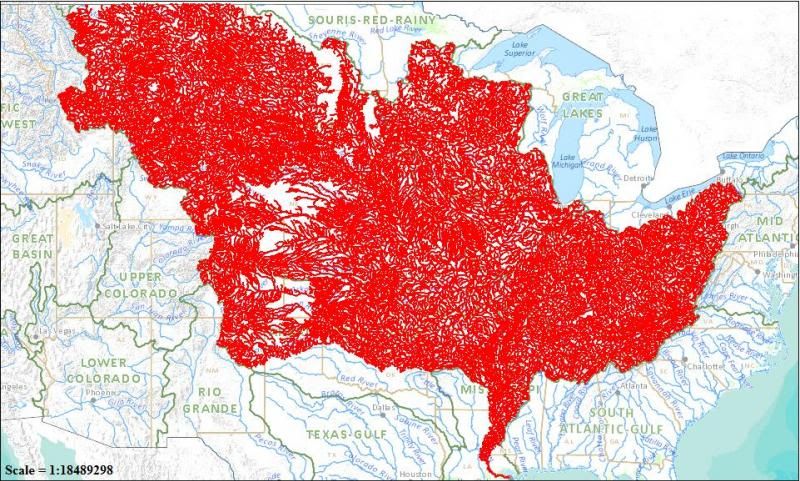
Thinking on a larger scale, let’s consider the Mississippi River watershed. The waters that come down by New Orleans originated in 31 different states as well as 2 provinces in Canada. Most of those states are in the major agricultural areas of our country, so aside from whatever random litter and mismanaged pollutants, there are also a lot of chemical pesticides and fertilizers washing off the fields and heading this way. Scary thought.
            
Globally, water is just as precious as it is here and still carrying the precarious status of being both threatened and threatening. We heard about major flooding along the Gulf Coast in Alabama and Florida last week, with those storms that largely missed us in Louisiana. There were also major floods in the Middle East in the past few days, affecting refugee communities in Syria and causing a landslide in northern Pakistan. The rainy season in some African countries has caused a surge in mosquito populations, carrying diseases like malaria. The Carteret Islands of Papua New Guinea in the Pacific have been completely and permanently evacuated because the seas have gotten too high too consistently to stay any longer.
             
And what about pollution? It’s a scary world out there. We have giant floating islands of trash collected in the Pacific. Oil spills don’t just happen in Alaska and the Gulf of Mexico, they happen in Kuwait in the Middle East, in Russia, in Scotland, in Nova Scotia in Canada. Over 800,000 people around the world lack access to safe drinking water, leaving people susceptible to waterborne illness like dysentery, which can kill in days if left untreated. 3.4 million people die each year from water-related illnesses. That’s like 75% of the population of Louisiana dying every year.
             
And to think, we as a planet share exactly ONE supply of water.
             
I don’t tell you all of this to scare you or keep you up at night. I tell you this because to fix it, we have to start somewhere, and I think learning about it is a good place. Creation is ongoing. Romans 11:36 reads, “For from him and through him and to him are all things.” God created the world in Genesis, and will create a new world according to Revelation. The world we are in now is not static, but ever changing according to the actions taking place on it, for better or worse.
           
The good news is, God’s forgiveness is also ongoing. It seems like forever ago, but it was only two weeks ago that we celebrated Easter, the penultimate example of forgiveness. God did not leave us here to suffer from our own miscalculated actions. God loves us so much, that we received Jesus as a sacrifice to wash us clean from the terrible things we have done to each other and the earth we live on.
             
However, this free and clear doesn’t mean we get to keep coasting and just keeping doing what we’ve been doing. We need to take this truly awesome gift of forgiveness and new life to create a new life here and now. As a church, we have a great network set up to handle these injustices. I attended a conference for the Presbyterians for Earth Care group in October, an association of members of PC(USA) who are focused on caring for creation, seeking environmental wholeness with social justice. One morning, our keynote speaker asked the room, “What are you experts in?” The answers were varied. Biology. Chemistry. Architecture. Education. Geography. Engineering. Art. Pastoral care. Political science. Math. Agriculture. The list went on. Our keynote speaker pointed out, “Where else will you just find this diverse a group of experts already together?” That really resonated with me. Right here, in this church, in this congregation, in this denomination, we have a diverse group of experts. Environmental injustices happen in many ways, for many reasons, with many results that can be measured using many methods. We as a church hardly need to outsource to get help combating these types of problems. We have a network of experts right here who can approach such issues from the many angles they present.
             
So from our diverse group of experts, certainly there are some lawyers and judges, but even people without law degrees can seek justice. Academically speaking, environmental justice goes far beyond regulations and governance, including environmental science, political science, planners and policy makers, as well as ecologists and other environmentally inclined fields. As geography major, I studied environmental justice as problems with sustainability and access to resources vary across space according to local environments, customs and governments. But environmental justice is a bigger social movement that includes anyone who wants to see a fair distribution of environmental benefits, like having access to good farmland and timber wood and oil reserves, as well as the burdens, like soil erosion, deforestation and the many pollutants that come with petroleum exploration. That means no matter who lives in a community, whether they are rich or poor, young or old, conservative or liberal, Catholic or Protestant or something else entirely or nothing at all—doesn’t matter. Just as we want to be included in the wealth of resources, we need to share the weight of the side effects, too.
             
Seeking environmental justice in this community might come in different forms. There’s something for every expert! Maybe you have a heart for the pollution that affects the Mississippi and Atchafalaya Rivers. You can support organic agriculture or practice it at home in your own garden. You can participate in watershed clean up projects. You can support organizations that raise awareness and affect policy change to protect these precious waterways, as well as countless other bayous and lakes in this region. There are many organizations planting grasses and trees to replenish areas affected by erosion. Consider driving a more fuel efficient vehicle or finding other alternative sources of energy for your home and car. Contact elected officials encouraging policy change to protect the people who work so hard to supply so much of this country’s energy, and the land they live on and live off of.
             
It’s about much more than just “going green” though—it’s about being aware of the people and places we don’t always see, and how they might be affected by our every day choices, and then finding ways of partnering with them so that we can all share in the glory of God’s creation as well as our shortcomings as the temporary managers of it all.
             
We share a very finite amount of water on this planet. It can be easy to forget about the injustices in the world and the mismanagement of our natural resources when it’s so readily and safely accessible in this country. It is important to remember the source of these waters upstream as well as our neighbors downstream who will be affected by our every action. Isn’t that what our baptism in this church is? Remembering our Creator as well as our neighbors.
             
When we accept the living waters that Jesus is talking about with the Samaritan woman, and we accept new life in Christ, we accept a new life and a new creation here and now. And we share that new life with the entire world around us, no matter how nearby or far away or similar or different they are, just as Christ was ready to share a drink of water with a Samaritan woman, who was startled that a Jew would come to the same well at all. As God’s forgiven people, let us use that blessing to bless and honor others, whether those “others” are people, the plants and animals that surround us, or the water that we all survive and thrive on.
             
And I mentioned water in some form 96 times, in case anyone was keeping count. Amen.

22 April 2014

Happy (Earth Day)

Happy Earth Day! Today also sort of marks a few other things:
  • Three years ago, I successfully defended my Masters thesis. (Earth Day was Good Friday in 2011.)
  • Two Good Fridays ago in 2012, I had my first day volunteering with NRCS, which has been one of the most awesome and formative parts of my journey in vocational discernment.
  • Today leaves 100 days left in New Orleans.
My, it's been a busy few years.


I'm not really sure what to say. It hasn't been easy. Not over the course of the past six years since finishing college and not finding full time work, not in the past three since finishing grad school and still not finding full time work, not this past year volunteering my service. Living in community is hard. Knowing I can't fix the coast is hard. Planning a wedding is hard (mostly, being apart from the groom is hard). Being far from my family and friends and home is hard.

To celebrate my final 100 days serving in South Louisiana, I'm jumping on the 100 Happy Days bandwagon. I'm not much of one for bandwagons but I love being happy. I tend to be a pretty optimistic person (how many times have you heard me sincerely say "best day ever"?) and I love noticing the little things that make this world a wonderful place. Despite the challenges of my job, my community, my geography, my future, I'd really like to stay focused on the many, many beautiful things I get to see and be part of each day.

To celebrate Earth Day, I've decided to take a day trip to the beach in Mississippi somewhere. I'll decide where when I find it.

To celebrate life in general, I will keep you updated on my 100 days of happy, and encourage you to be intentional about your own happiness.

06 April 2014

Paddle Bayou Lafourche

I just got back from my first overnight canoe trip since 2007. OH MAN IT WAS AWESOME. My friend Lindsey joined me for a really great long weekend on the bayou. We paddled 52 miles over 4 days through people's back yards, enjoying local food, conversation, flora, fauna, and music. 

Paddle Bayou Lafourche is an annual event put on by the Barataria-Terrebonne National Estuary Program, a great organization that I have enjoyed many good resources from this year as I learn and teach about wetlands issues in the region. National Estuary Programs came out of the EPA's Clean Water Act in the late 80s. At home in New Jersey is another one-- Barnegat Bay Partnership.

Thursday, from Donaldsonville to Napoleonville: It was a tough first day. Paddling down the bayou on a windy day is much like paddling in a wind tunnel... in the wrong direction. We faced gusts up to 20mph. I hadn't been in a canoe in almost seven years, so my arms were a bit out of practice to begin with, but this was rough for everyone. We paddled almost 18 miles, about 11.5 of which were before lunch. We felt a little hopeless, but we did it, and enjoyed a good dinner and glorious night of camping at Madewood Plantation.

Friday, Napoleonville to Thibodaux: The wind died down, but the forecast remained questionable. We lucked out with only a little bit of rain on and off as we continued to explore the bayou. We landed at the Jean Lafitte museum in town, having done just shy of 16 miles.

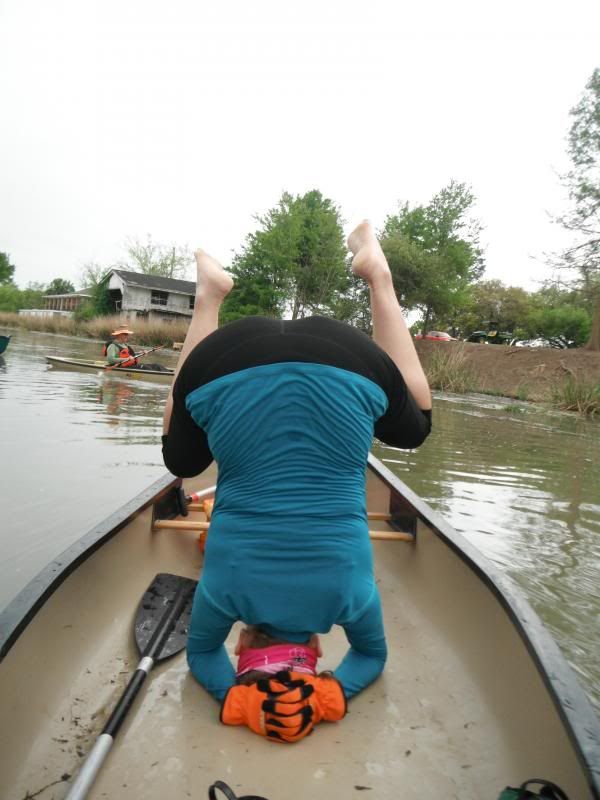
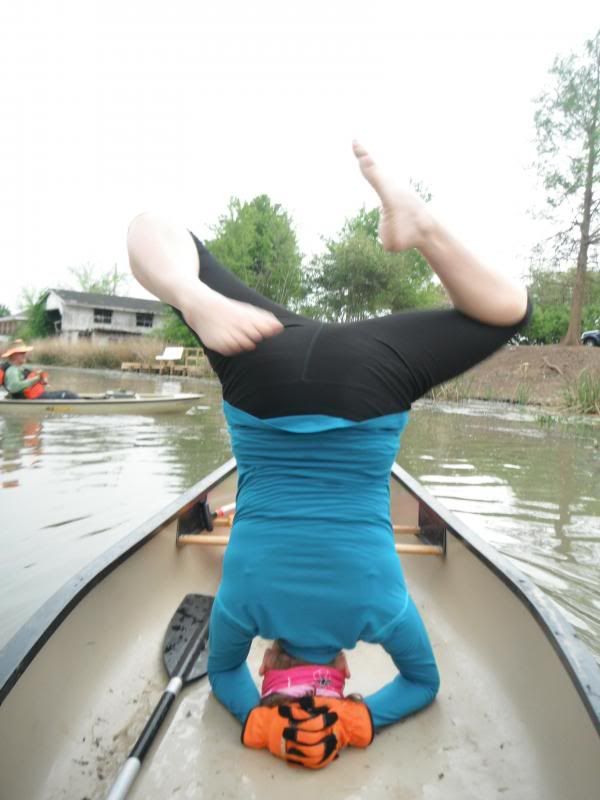
Saturday, Thibodaux to Raceland: We launched from Nicholls State University, just below Jean Lafitte, because there's a weir in the bayou between the two and the BTNEP staff probably didn't want to deal with all of the idiots who would have tried to paddle down it. Lindsey and I finally got into a rhythm, finishing ahead of a lot of people who doubted we would survive the first day. We also finished just a few minutes ahead of torrential downpour and hail. Right before we landed after about 15.5 miles, Lindsey decided to follow through with a wild idea she came up with early in the day-- yoga on the bayou, or "bayoga" as we came to call it. She decided to do a headstand while I balanced the canoe:

 photo DSCF9828_zpsa822146c.jpg

 photo DSCF9829_zps264ee422.jpg

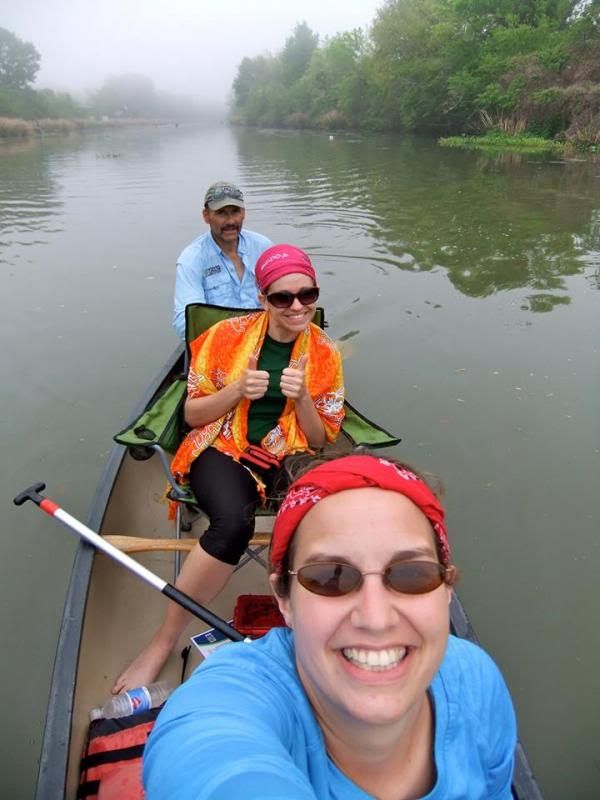
Sunday, Raceland to Lockport: Just a short 5.5 miles to finish up. BTNEP's Water Quality Coordinator, Andrew, was without a paddling partner for the last day and asked to join us. Lindsey enjoyed sitting in a chair in the middle of the canoe asking lots of questions about the bayou. We had paddled beside him and his canoe partner Michael, BTNEP's Invasive Species Coordinator, the three days before, peppering them with questions about soil science and ecology, so it was cool to have him on board answering our environmental questions the entire time without worrying about keeping up with him.

 photo 1794733_10100943266333696_1726868341_n_zps41efdf8c.jpg

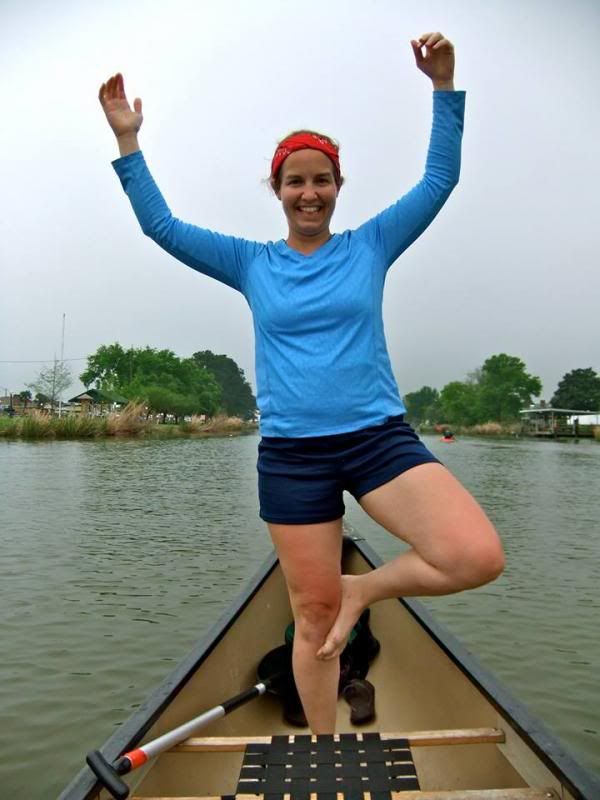
The day started off very foggy, but we once again beat the rain after a late decision to follow through with the final stretch at all. The trip ends in Lockport, because any further south and we'd start running into enormous ships. Just before we landed, I had Andrew balance the canoe while Lindsey took a picture of my bayoga efforts (obviously going for a tree):

 photo 1546037_10100943290694876_1622215352_n_zps353625c6.jpg


It was so nice to go out on an adventure for a few days. This was technically work-related for me, so I did spend some time contemplating Bayou Lafourche, which is the main source of drinking water for the region--
  • A few weeks ago, BTNEP hosted a massive bayou cleanup, which usually involves hundreds of volunteers along 106 miles of Bayou Lafourche (we only paddled 52 miles). They pick up thousands of pieces of garbage ranging from cigarette butts (please please please stop throwing cigarette butts out the windows) to plastic bottles (please please please recycle those and/or stop drinking bottled water when it's totally unnecessary) to tires, toilets, and couches. Full frightening details from last year here. I will say it again: this is the main source of drinking water for the region, for tens of thousands of people.
  • The first day, as we paddled straight into 20mph gusts, it was all too clear a picture of how easily salt water flows back up the bayous in nothing more than a stiff wind. When the wind wasn't blowing, the water was completely slack. No current. Tough to paddle, but also tough for it to remain fresh, flowing off the Mississippi at Donaldsonville.
  • As we paddled under local bridges, cars drove over our heads. Some of the bridges were grates. As I felt the rainwater drip off one onto my legs and head, I shuddered at the thought of leaky cars just letting fluids straight into... the drinking water supply.
  • We wound past countless signs warning of gas and oil pipeline crossings. Again... slow leaks into the drinking water, distinctly possible.
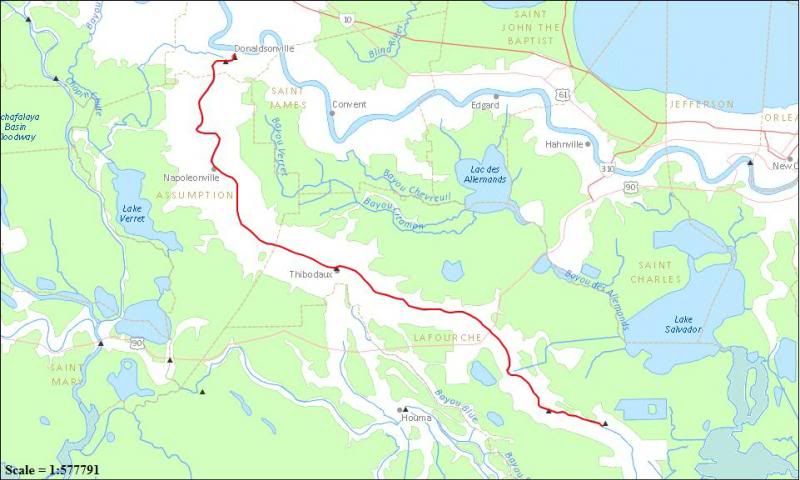
Plus, let's consider the greater watershed with the help of the Department of the Interior's Streamer Tool. Here's the portion of Bayou Lafourche that we paddled:
 photo BayouLafourche_zps0f4d1aeb.jpg

And here is the watershed of the Mississippi River, down to Bayou Lafourche:
 photo BayouLafourcheMississippi_zps472a7696.jpg

That's 31 states, plus two Canadian provinces, full of agricultural runoff, fluids from leaky beat up cars, cigarette butts from careless people, and other awful things.

I would really encourage you to think about your relationship with your home watershed, whatever it may be. Water is so precious.

I did not spend the entire trip having nightmares, but the whole awareness angle that BTNEP is playing by hosting this event on this particular bayou definitely worked. The vast majority of it was relaxing and wonderful. There were at least six different kinds of bread pudding served over the course of the trip. There was a man sitting on his fishing dock playing his accordion for the paddlers. There was bayoga and shenanigans with Lindsey and other people around us. There were blooming black locust trees, and swaying cutgrass, ducks and geese and swallows and red winged blackbirds, and lots of people waving hello and speaking French and smiling and many, many other beautiful things.